





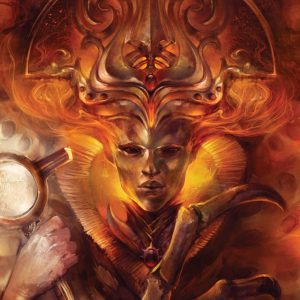


The Lazarenes are not knights and only an order in the very loosest of senses. They could perhaps be called a movement, but the circumstances of their birth at the Last Battle of the Fall have inalienably tied them to the Orders that were born in that hellish crucible.
Origins:
The Lazarenes, as the Order of St Lazarus is commonly known, are not born of the warriors of the Last Legion. Rather, their origin lies in more humble beginnings. At the height of the battle, when Hazlia revealed his most dangerous gambit and almost overwhelmed the defenders, Kleon power washed over his troops, healing them of injury and revitalizing their leaden limbs. Unknown to him, his power flooded across the huddled masses of rejected humanity: the old, the sick and the infirm, who having reached the Claustrine Mountains, could not continue. Abandoned by kith and kin, they cowered at the base of the massive walls as Hazlia and his legions seethed against them and were well within the range of Kleon’s blessings as he deployed his divine panoply. Led by Lazarus, a leper who had long given up hope only to have it rekindled by Kleons Blessings, their rabid assault on the massed hordes of Hazlia gave the defenders precious time to rally and redeploy, saving the defenders and setting the stage for Kleon’s last gambit against Hazlia: direct manifestation.
The divine duel, Leander’s betrayal and the subsequent shattering of the Legion into the Orders are well documented facts, at least by the Orders. But that doesn’t deal with Lazarus, who hurled himself upon the incapacitated form of Kleon, and took the combined strength of four knights to pull him off. It does not speak of his disavowal of the Orders or his promise before the recumbent form of the only god to show him mercy to protect those who could not. Disillusioned he departed, despite overtures of friendship from the nascent Orders, and so passed from history into legend.
Early History:
While Lazarus himself may have passed into myth and legend, the actions of his followers most certainly did not. In those lawless, turbulent times before after the Last Battle but before the return of the Orders, the only rule was that the strong rule and the weak suffered a heavy yoke. The Lazarenes, veterans of a horrible conflict, their souls seared by the sights they had seen and their hearts made hard and bitter by the betrayals they had survived, descended upon those who abused their fellow man with not an ounce of mercy in their seared hearts. Stronger, faster and willing to trade any injury, even death to achieve their goal, none who they marked for death was safe. Brutal, public executions were their signature style, and countless petty tyrants met their fate at their hands. This brutal campaign met with stiff resistance from the rising nobility, and despite their superhuman strength, took a toll on their numbers and cohesion even as the nobility consolidated their power base and cooperated. While ultimately defeated and driven underground, a bruised and battered nobility had little strength left to oppose the now returning Orders, and acquiesced to their demands without any major resistance. As far as the Lazarenes were concerned their campaign was a success. Countless lives had been spared as a needless generalized conflict was avoided and the only cost was their lives, and those of a few hundred corrupt tyrants.
Initiation:
Unsurprisingly, the Initiation of new members into the Order of St Lazarus does not follow the pattern of shard implantation that the orthodox Orders follow. The Lazarenes developed their initiation as a test, rather than a confirmation, during the trying final days of their first campaign. To prove their allegiance to the cause, they were invited to drink from a chalice into which Lazarus himself had bled. While Kleon Blessing had allowed the Lazarenes to fight despite injury, exhaustion or disease, it had not cured them of the disease, merely allowed them to ignore the ravages of it. They thus ensured that only the truly faithful and committed joined the cause. What they discovered was that those who partook the blessing from Lazarus himself also gained a portion of his blessing, as did those who drank from his disciples blood, and so forth. As a result, to this day, all Lazarenes can trace their blessing to Lazarus himself, further reinforcing the bond of faith, tradition and conviction that binds them.
Activities:
Today the Order of St Lazarus has spread throughout the Hundred Kingdoms and continues their crusade against those who would abuse their power and oppress the helpless. Their supporters number in the hundreds of thousands and would probably number in the millions were their methods so brutal or extremes evidenced by the onset of the Red Years. As it is, the Lazarenes operate almost entirely underground and covertly. They have a vast network of sympathizers and supporters who feed them with information, resources, safehouses and most importantly, targets. Lazarenes sometimes operate independently, but most often do so in small groups of no more than a dozen individuals. Utilizing sewers, catacombs and forgotten mines, not to mention the efforts of their sympathizers, they are able to infiltrate almost any fortress or compound. Once inside, the pretense of subterfuge is discarded in favor of raw power. The blessing coursing through their veins makes them strong as two men and tireless to boot, while the disease that afflicts them makes them almost immune to pain and has long since cured them of the fear of death, making them unstoppable in close quarters.
The brutal execution of their enemies and terrifying appearance of the Lazarenes themselves have made it easy for the nobility to cast them as villains, but little could be farther from the truth. The Lazarenes are incredibly scrupulous when it comes to collateral damage and innocent bystanders and whatever resources they liberate are universally shared with the poor and destitute. Their aura of brutality and the theatricality of their incense weapons and flaming braziers drives the political messaging home, but at a tremendous cost to their image and standing amongst many of those they seek to help.
Organization:
Ironically, the Lazarene’s structure when viewed from the outside is remarkably similar to that of the other orders, with their supporters and sympathizers replacing the lay brothers and the Lazarenese themselves being the militant arm. The Lazarene fall into two broad categories, the Penitents and the Martyrs, with the larger bulk of their forces composed of Penitents: Lazarenes who have received the blessing but whose disease has not progressed. Strong, relentless and inured to pain and suffering they are almost impossible to kill. Massive shields protect them from their main counter, ranged fire. Once they close grips with the enemy, their relentless strength and brutal pressure of their shieldwall is too much for most enemies to endure.
At the other end of the spectrum lie the Martyrs, those Lazarenes whose long years of service and campaigning are coming to an end due to the advancing disease. True to the fanatical credo of their Order, these fanatical combatants eschew the shield entirely, arming themselves with the heaviest weaponry they can find and hurling themselves at the foe with reckless abandon. Incredibly strong, absolutely immune to pain and long familiar and comfortable with death, they are perhaps the perfect warriors, willing to trade their life for inflicting as much damage as possible in as terrifying a manner as possible.